
Inpatient and outpatient rehabilitation: two options after discharge
“The operation went well.” Every family wants to hear this sentence, and right after it usually comes a question few people have a ready answer to: what now? A stay on the surgical ward after a joint replacement or another operation now lasts only a few days. The discharge letter recommends continuing rehabilitation, and the patient and family suddenly have to decide: home and then to therapy sessions, or inpatient rehabilitation?
This decision has a significant effect on the speed and quality of recovery, and it is made at a time when there is neither the time nor the energy to research the options.
Outpatient rehabilitation means that the patient stays at home and comes in for therapy, usually several times a week, for a session that as a rule lasts up to an hour. Everything else (moving around the house, bathing, meals, homework exercises) is left to the patient and the family.
Inpatient rehabilitation means that the patient moves from the surgical hospital or from home to a specialised facility where they stay, eat and undergo intensive rehabilitation, with medical supervision, nursing care and therapies spread throughout the day. The length depends on the condition, usually several weeks.
Neither of these options is better in itself. They differ in who they are intended for and what they offer at which stage of recovery.
Five key differences
1. Intensity of therapy
In outpatient rehabilitation the patient completes a few hours of therapy a week. In inpatient rehabilitation the programme runs every day, in several blocks: individual exercise therapy, therapy in the pool, physical modalities, gait training. In a few weeks this adds up to a number of therapy hours that would take considerably longer as an outpatient. In the early phase of recovery, when the body responds very well to stimulus, this intensity pays off most.
2. Continuity and monitoring of progress
The same team, the doctor and the physiotherapists, follows the patient from day to day and adjusts the programme to their progress immediately, not at a follow-up appointment a month later. If swelling, pain or a plateau in progress appears, the team responds the same day.
3. Safety
The first weeks after surgery are a period of increased risk: falls, wound problems, side effects of medication. In an inpatient facility the patient has nursing care day and night, in a step-free environment. At home, the family takes on this role, day and night.
4. The burden of organisation
Outpatient rehabilitation means transport to every session. For a patient who has just had surgery and is not allowed to drive, this means arranging for someone to accompany them several times a week. In inpatient rehabilitation everything is under one roof: accommodation, meals, therapies and medical supervision, with no driving.
5. Recovery without compromise
At home, recovery competes with the household, the stairs and caring for others. In inpatient rehabilitation, recovery is the main job: with meals adapted to recovery, rest between therapies and time devoted to regaining strength.
Who benefits most from inpatient rehabilitation
- patients after a hip or knee replacement who want to make full use of the crucial first weeks
- people who live alone or whose household members work and cannot take on daily care
- older patients, especially after a hip fracture, who need nursing care and a safe environment as well as therapy
- patients whose home is not adapted for recovery: an upper floor without a lift, a narrow bathroom, steps up to the entrance
- patients after more complex operations (spinal surgery, polytrauma, several injuries at once), where progress without daily expert guidance is slow and uncertain
- athletes and active people who want a short and safe route back to form
On the other hand, outpatient rehabilitation is a perfectly good choice when the operation was minor, when the patient is younger and mobile, has support at home and can get to therapy without much effort. Many patients combine both: after an inpatient programme they continue their recovery as outpatients, with exercises they have learned to do correctly.
What a day of inpatient rehabilitation looks like
A patient's day, say in the second week after a knee replacement, might look like this:
- Morning: waking up without rushing, breakfast, the morning ward round. Then the first therapy block, individual exercise therapy with mobility and strength exercises suited to that phase.
- Late morning: physical therapy to reduce pain and swelling, then gait training. This is followed by rest or a walk until lunch.
- Afternoon: the second therapy block, for example therapy in the pool, where the buoyancy of the water makes possible exercises that are still too demanding on dry land.
- Evening: dinner, free time, a family visit.
From week to week the programme changes: the load increases, walking aids are gradually put aside, and towards the end of the stay the focus shifts to independence (stairs, longer distances, exercises the patient will continue alone at home). We give more practical details in our article what to bring and what a day looks like.
When to think about rehabilitation: before or after surgery?
Before. If the operation is planned, a place in inpatient rehabilitation can be arranged in advance, so the move from the surgical hospital goes smoothly, without a gap. As the Zelendur team points out (Jutarnji list, 9 November 2026), the first weeks after a hip or knee replacement are crucial for the outcome. The body can also be prepared before the operation, which we write about in our article on prehabilitation.
When to contact a doctor straight away
Whatever the form of rehabilitation, call 112 (the European emergency number) straight away for sudden shortness of breath or chest pain, and after hip surgery for sudden severe pain with a shortened or outward-turned leg. Contact a doctor the same day for a swollen and painful leg, redness or discharge from the wound, or a temperature above 38 °C.
Inpatient rehabilitation at Zelendur
Specijalna bolnica Zelendur in Samobor is the first private specialty hospital for physical medicine and rehabilitation in Croatia. The stay begins with a medical examination, a nursing assessment and a physiotherapy assessment (each about 45 minutes), and the personal plan is adjusted every day. You receive your schedule for tomorrow the day before.
Therapies take place throughout the day, Monday to Friday 8 am to 7 pm and Saturday 8 am to 3 pm, so the programme does not have to be squeezed into the morning, and there is time for proper rest between therapies. You also have accommodation in the 4-star hotel wing or in hospital rooms, all step-free, and round-the-clock nursing care.
Are you considering inpatient rehabilitation for yourself or a family member? If you are not sure what is best for you, get in touch: we will review your medical records free of charge and suggest the next step.
Frequently asked questions
What is the difference between inpatient and outpatient rehabilitation?
In outpatient rehabilitation you live at home and come in for therapy, usually several times a week for an hour at a time. In inpatient rehabilitation you stay at a facility, have therapy every day in several blocks, and have medical supervision and nursing care day and night.
Who is inpatient rehabilitation for?
It benefits patients most after a joint replacement, older people after a hip fracture, people who live alone or whose home is not adapted, and patients after more complex operations. It also benefits active people who want an intensive and safe return to form.
Is outpatient rehabilitation enough after knee surgery?
For younger, mobile patients with support at home who are able to get to therapy, it can be enough. After a knee replacement it is important that therapy in the first weeks is regular and intensive enough, because at that stage it strongly influences the final range of movement.
How long does inpatient rehabilitation last?
The length depends on the operation, your condition and your progress, and it is usually several weeks. Your doctor decides this based on an assessment and regular monitoring of your progress.
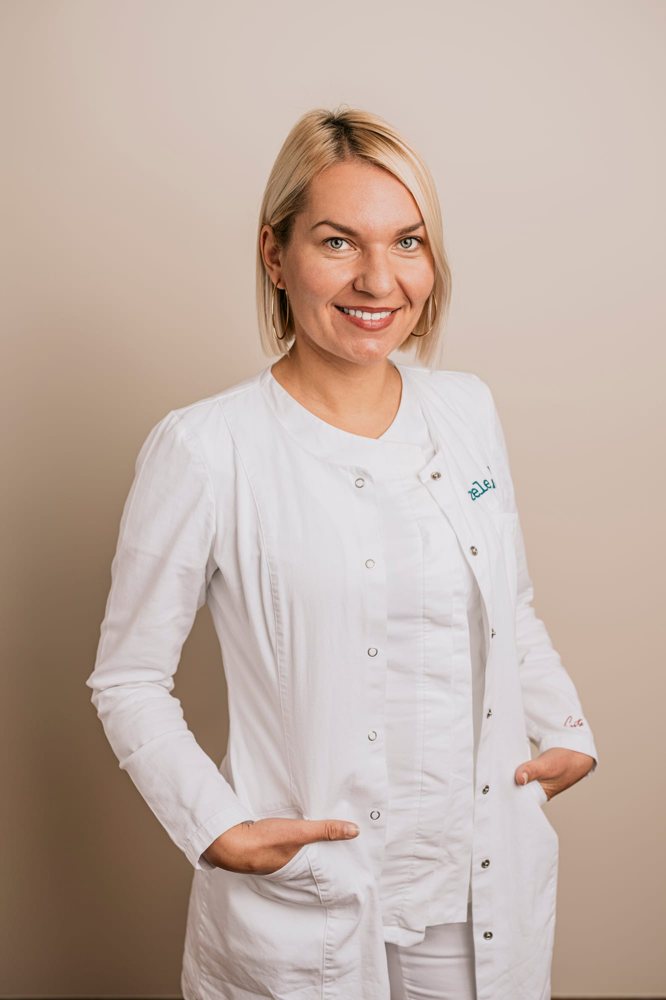
Specialist in physical medicine and rehabilitation with experience in rehabilitation after orthopaedic surgery and in diagnostic musculoskeletal ultrasound. Before joining Zelendur in 2026, she worked as a specialist at Topusko Health Resort (Lječilište Topusko). On this website she provides the medical review of expert articles.
Biography and articles →Next content review: 18 May 2027. This text is for information only and does not replace an examination by a doctor.
Sources
- Joint replacement (primary), hip, knee and shoulder, guideline NG157 (NICE, 2020): nice.org.uk/guidance/ng157
- Rehabilitation, fact sheet (WHO): who.int/news-room/fact-sheets/detail/rehabilitation
- Hip replacement, recovery (NHS): nhs.uk/conditions/hip-replacement
- Interview with the team of Specijalna bolnica Zelendur (Jutarnji list, 9 November 2026): jutarnji.hr